Ego-Human Motion Prediction with 3D-Aware LLM

Visual Intelligence Lab, KAIST
ECCV 2026
*Indicates Equal Contribution
Ego3DLM teaser: given a prompt, three-point tracking, a 3D scene, and 2D egocentric video, a single language model jointly outputs past/future 3D pose and their language descriptions.

Ego3DLM incorporates the semantic context of the surrounding 3D environment together with 2D egocentric video and three-point tracking to jointly generate past and future 3D poses and their corresponding language motion descriptions — all in a single autoregressive pass.

Abstract

Anticipating human motion from an egocentric perspective is fundamental for proactive assistance in AR/VR, human–robot collaboration, and embodied AI. While recent works incorporate language as a semantic prior to reduce the ill-posed nature of egocentric forecasting, they largely neglect the 3D spatial and semantic context that governs how motion unfolds, and treat pose and language prediction as separate inference streams.

We introduce Ego3DLM, built on two core principles: accurate motion forecasting requires explicit spatial and semantic understanding of the 3D environment, and pose and language must be predicted holistically in a single pass, since motion is inherently tied to the semantic interpretation of actions being performed. Given three-point tracking, 3D scene features, and egocentric video, Ego3DLM simultaneously decodes past pose, future pose, past narration, and future narration in a single autoregressive pass, grounding predicted poses and descriptions in one another to enforce cross-modal and temporal consistency.

We adopt a three-stage training scheme: (1) spatial-semantic scene awareness pretraining; (2) holistic instruction tuning over all four outputs in a single pass; and (3) GRPO-based reinforcement finetuning with intra- and inter-modal rewards that directly optimize pose-language fidelity. Experiments on the Nymeria benchmark demonstrate that Ego3DLM achieves state-of-the-art performance across future motion prediction, past motion tracking, and motion description, showing that 3D scene grounding and holistic cross-modal prediction yield physically plausible and semantically coherent motion forecasts.
1. 3D scene grounding

Accurate motion forecasting demands explicit spatial and semantic understanding of the 3D environment — the physical constraints, free space, and object-level affordances that govern possible movements.

2. Holistic single-pass prediction

Pose and language are predicted together in one autoregressive pass, since human motion is inherently tied to the semantic interpretation of the actions being performed.

Method

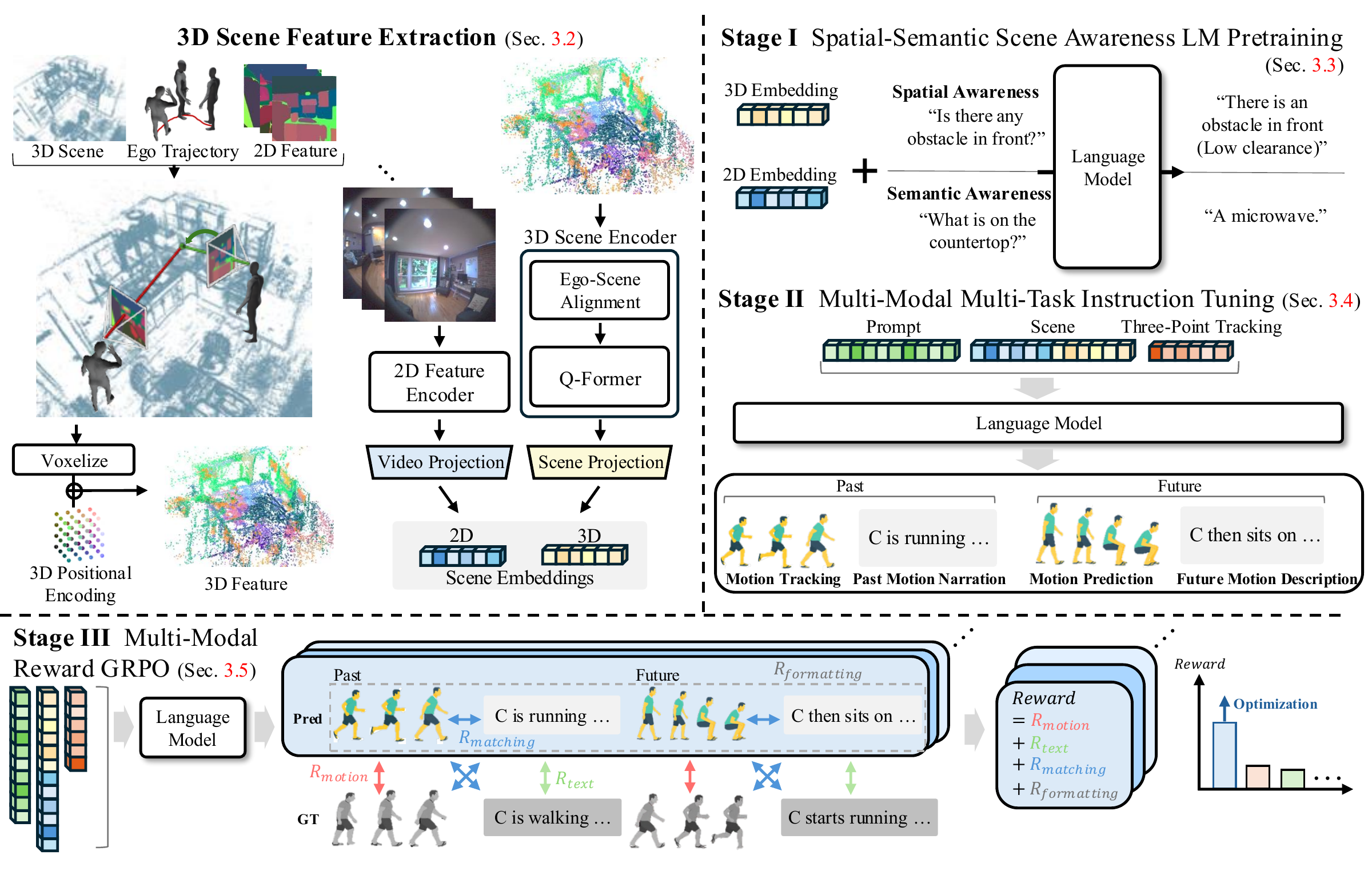
Given three-point tracking, 3D scene features, and egocentric video, Ego3DLM decodes all four outputs — past pose, future pose, past narration, future description — in a single autoregressive pass, trained in three stages.

Overview of the Ego3DLM framework: 3D scene feature extraction, Stage I spatial-semantic pretraining, Stage II instruction tuning, and Stage III multi-modal reward GRPO.
Overview of the Ego3DLM framework. 3D Scene Feature Extraction: 2D semantic features are extracted from egocentric video frames and lifted onto the 3D point cloud; the feature-enhanced point cloud is fed into a Q-Former to produce compact scene query embeddings. (I) Pre-training aligns scene, motion, and language via spatial and semantic objectives; (II) Instruction Tuning trains simultaneous single-pass generation of all four outputs; (III) GRPO refines the model with intra- and inter-modal rewards for pose-language fidelity.
Stage I

Spatial-Semantic Scene Awareness Pretraining

The LM is pretrained on automatically generated spatial and semantic QA pairs from 3D scenes, instilling obstacle awareness and object-level semantics before any motion reasoning.

Stage II

Multi-Modal Multi-Task Instruction Tuning

A single autoregressive sequence — spatial scene description → past & future motion → past & future descriptions — propagates spatial reasoning through pose into language.

Stage III

Multi-Modal Reward GRPO

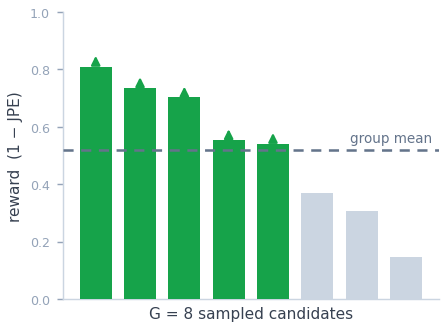
Reinforcement finetuning with intra-modal (JPE, BLEU) and inter-modal (motion–description matching) rewards directly optimizes accuracy and cross-modal fidelity.

Spatial-Semantic Scene Awareness Data

To ground the language model in the 3D environment, we automatically construct a scene-awareness QA dataset — approximately 535K spatial and 115K semantic QA pairs across 208 scenes — augmenting Nymeria, which lacks explicit scene descriptions.

Spatial-semantic scene awareness QA dataset generation: semantic awareness QA types on the left and spatial awareness directional clearance on the right.
Semantic Awareness: for each 3D scene we use egocentric video to auto-generate QA pairs across six types (object, place, object nature, color, number, other) that describe and reason about the environment. Spatial Awareness: the environment is partitioned into three angular sectors (front, left, right), and QA pairs predict directional clearance levels and the most navigable direction.

Explore the semantic QA — interactive

Browse egocentric frames and the automatically generated question–answer pairs grounded in them. Pick a scene and filter by QA type (object, place, color, object nature, …).

Open QA browser in full screen

Explore the spatial awareness — interactive

Directional clearance assessed as the person moves: low, mid, and high free space in the front/left/right sectors, with the most navigable direction highlighted. Drag to orbit.

Open spatial viewer in full screen

Results

On the Nymeria benchmark, Ego3DLM achieves state-of-the-art performance across future motion prediction, past motion tracking, and motion description.

14.1%
JPE for future motion prediction
vs. best baseline
36.7%
APE for motion tracking
vs. best baseline
60.0%
BLEU-4 for future description
vs. EgoLM
56.8%
Motion–language alignment
distance vs. EgoLM

Motion prediction and tracking. Best results in bold; arrows denote the better direction.

Method Motion Prediction (3 modes) Motion Tracking
APE↓JPE↓ADE↓ADE2sFDE↓FDE2sFID↓Div.↑ APE↓Upper↓Lower↓J.A.↓Root↓
FIction206.2564.7558.3416.7904.3494.90.32750.7432181.1114.0282.331.2834.81
EgoLM (GT motion)168.8583.9540.0299.01,059.5494.81.38400.0055
EgoLM (Inst. tuning)184.9579.4552.6329.9983.6519.20.21370.6142161.995.6265.633.6324.01
UniEgoMotion151.5424.3409.7223.9720.5360.40.15300.9022152.279.4233.326.4822.71
Ours (Ego3DLM)147.9364.5343.9205.9648.1312.60.01601.062496.453.1152.722.3019.57

Motion description and narration. x-y Align. denotes motion–text alignment distance (dpp).

Method Future Motion Description Past Motion Narration x-y
Align.↓
Bleu-4↑Bleu-1↑RougeLSBert↑R@3↑dpg Bleu-4↑Bleu-1↑RougeLSBert↑R@3↑dpg
LLM (Qwen 2.5 7B)0.02020.09700.23430.61200.19406.67300.02320.14770.22670.61830.19446.9648
EgoLM (Inst. tuning)0.06490.30020.26420.59000.26396.89929.8686
Ours (Ego3DLM)0.10390.38390.30040.62060.29116.35070.11070.39660.31950.64580.42644.94704.2571

Qualitative Results

Ego3DLM produces motion that conforms to both physical scene constraints and past context, while its simultaneously generated description faithfully reflects the predicted motion.

Qualitative comparison of motion forecasting and tracking against UniEgoMotion, EgoLM, and Ego3DLM without 3D scene.
Qualitative results for motion forecasting and tracking. The ground-truth (GT) past motion is shown in red, and predicted future motion in blue. For the future motion narration below the figure, green highlights phrases matching the GT, while red highlights incorrect or mismatched descriptions. Ego3DLM walks around the bed to the door, whereas the variant without a 3D scene penetrates the wall.

Interactive 3D Viewer

Explore the reconstructed 3D scene together with the predicted motion. Drag to orbit, right-drag to pan, scroll to zoom. Switch scenes, toggle each method, flip between forecasting and tracking, and scrub the timeline. Ground truth is grey; Ours (Ego3DLM) tracks it closely while baselines drift.

Open viewer in full screen

BibTeX

@inproceedings{bae2026ego3dlm,
  title     = {Ego-Human Motion Prediction with 3D-Aware LLM},
  author    = {Bae, Yujin and Jeong, Jaewoo and Kim, Hyeonseong and Yoon, Kuk-Jin},
  booktitle = {Proceedings of the European Conference on Computer Vision (ECCV)},
  year      = {2026}
}